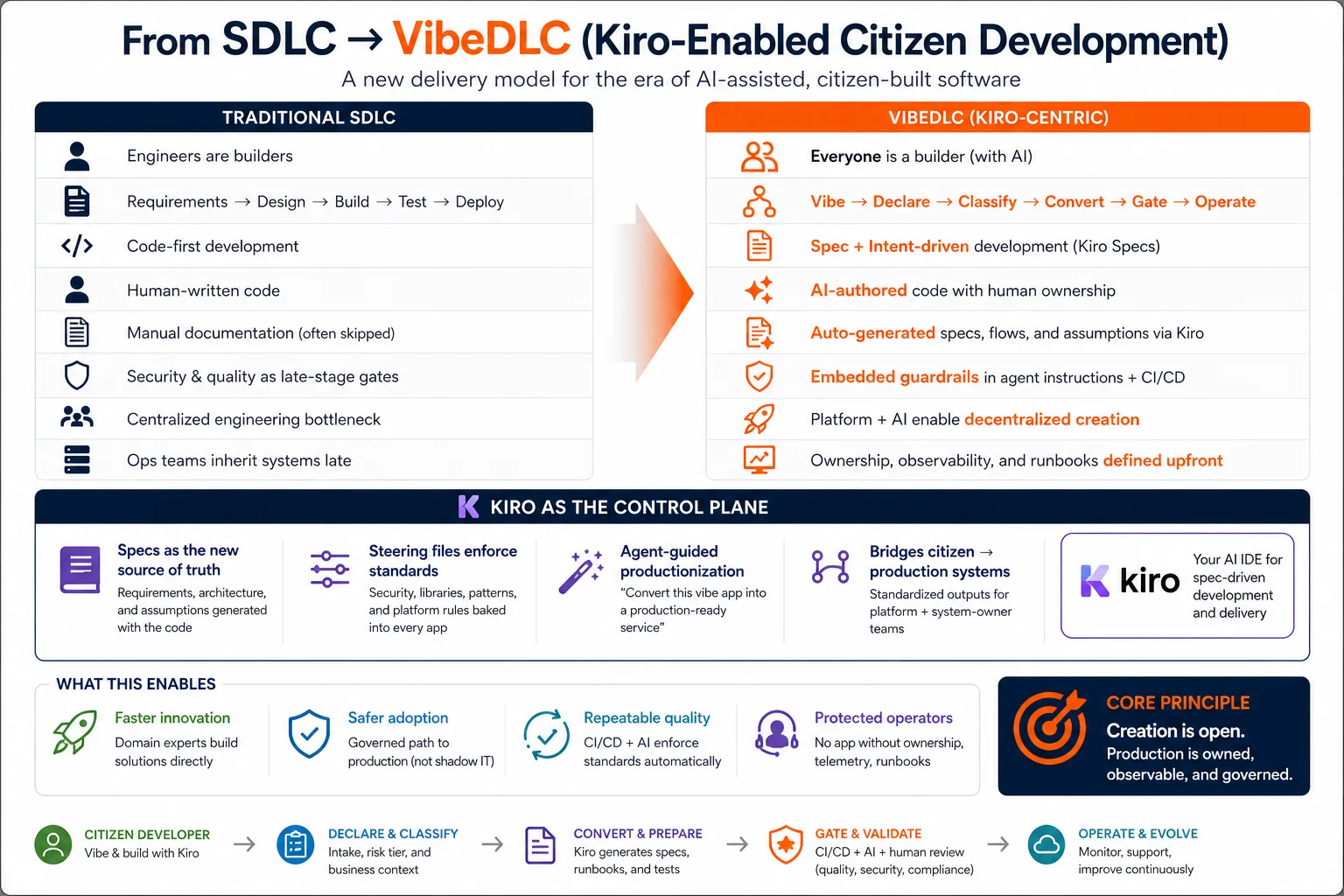
VibeDLC: Enabling Citizen Development Without Breaking Production
Modern engineering changed overnight.
Modern engineering organizations did not.
Tools like Claude Code, Codex, and Kiro have fundamentally changed who can build software. The old boundary between “engineer” and “non-engineer” is collapsing fast.
SOC analysts are building workflow dashboards.
Sales teams are automating quoting systems.
Operations staff are writing internal tooling.
Executives are generating prototypes during flights and demos between meetings.
And honestly? A lot of these applications are good.
Not toy projects. Not broken demos. Real, functional software solving real business problems from people closest to the work itself.
That is incredibly exciting.
It is also where most organizations immediately hit a wall.
The problem is no longer:
“Can someone build this?”
The problem is:
“Can the organization safely own this?”
The Real Problem With Vibe Coding
AI-assisted development democratized software creation faster than organizations adapted their operational models.
Most enterprises still assume:
- Software is written only by engineers.
- Engineering teams own every deployment.
- Production systems evolve through traditional SDLC workflows.
- Developers understand operational responsibility.
That assumption no longer holds.
A domain expert can now generate a functional web app in a single evening. But production software is more than working code.
Production software has:
- ownership
- monitoring
- rollback plans
- authentication
- logging
- support models
- security reviews
- dependency governance
- CI/CD enforcement
- operational accountability
The app itself is only part of the system.
The harder problem is everything around it.
Why Citizen Development Is Here to Stay
Organizations should resist the urge to shut this down.
History shows that when employees discover tools that dramatically increase productivity, shadow IT emerges if official processes are too restrictive.
The same thing is happening with AI-assisted development.
People will build things regardless.
The organizations that succeed will not be the ones banning AI-generated software. They will be the ones building safe pathways to absorb it.
That means enabling:
- rapid experimentation
- low-friction prototyping
- platform guardrails
- production governance
- operational accountability
All at the same time.
This is where a new operating model becomes necessary.
Introducing the VibeDLC
The traditional SDLC is still valuable.
But it does not fully address the realities of AI-assisted citizen development.
What organizations need is a companion lifecycle focused specifically on moving “vibe coded” software into maintainable, supportable production systems.
Call it the VibeDLC:
Vibe Delivery Lifecycle
The goal is simple:
- preserve the speed of AI-assisted innovation
- reduce organizational friction
- protect production systems
- protect system owners
- maintain engineering quality
The VibeDLC is not a replacement for engineering discipline.
It is a bridge between spontaneous innovation and operational ownership.
The Seven Stages of the VibeDLC
1. Vibe / Prototype
This is the creative phase.
The employee builds the thing:
- internal dashboards
- workflow automation
- reporting tools
- chatbot integrations
- operational helpers
- lightweight applications
Organizations should encourage this phase aggressively.
But there should still be guardrails:
- approved AI tooling
- no production credentials
- no regulated data exposure
- no direct production database access
- sandboxed environments only
The goal is safe experimentation.
2. Declare
Before an application becomes shared infrastructure, the creator should complete a lightweight intake.
Not a committee.
Not a six-week approval board.
Just metadata.
Example questions:
- What problem does this solve?
- Who uses it?
- What systems does it touch?
- Does it write data or only read?
- Does it use authentication?
- Who owns the business process?
- Who would support this in production?
This is less about approval and more about visibility.
3. Classify
Not every vibe-coded application carries the same risk.
A read-only dashboard is not equivalent to a privileged SOC automation pipeline.
Risk classification matters.
Example Tiering
| Tier | Example | Governance Level |
|---|---|---|
| Tier 0 | Personal utility | No production path |
| Tier 1 | Team-local dashboard | Lightweight managed deployment |
| Tier 2 | Internal workflow app | Standard platform controls |
| Tier 3 | Customer-facing or privileged app | Full production review |
This prevents organizations from treating every internal tool like a banking platform.
4. Convert to Production Shape
This is where AI becomes extremely powerful.
The citizen developer should not need to become a senior engineer overnight.
Instead, AI tools should help generate:
- architecture summaries
- dependency inventories
- data flow diagrams
- test plans
- operational risks
- observability requirements
- runbook drafts
- threat-model prompts
- deployment documentation
This is where tools like Kiro steering files, AGENTS.md, CLAUDE.md, and repository instructions become critical.
The organization teaches the AI:
“This is how we build software here.”
AI Needs Organizational Memory
One of the biggest mistakes organizations make is assuming prompts are enough.
Prompts are temporary.
Production standards need persistence.
That means creating reusable instruction layers for AI tools.
Examples:
.kiro/steering/AGENTS.md.github/copilot-instructions.mdCLAUDE.md
These files become organizational memory for AI-assisted development.
They encode:
- approved frameworks
- authentication patterns
- logging requirements
- observability standards
- testing expectations
- dependency policies
- forbidden patterns
- escalation requirements
Without this layer, every citizen developer starts from scratch.
With it, AI tools become force multipliers for engineering consistency.
5. Rebuild, Harden, or Wrap
One hard truth:
Most overnight prototypes should not deploy directly to production.
That does not mean the prototype failed.
It means the prototype proved value.
Organizations should choose one of several paths:
- Promote → harden the existing app
- Rebuild → use the prototype as executable requirements
- Wrap → place the logic behind managed services
- Retire → preserve the idea but not the implementation
This decision should depend on:
- business value
- operational complexity
- security risk
- maintainability
- ownership readiness
Platform Engineering Becomes Essential
The more citizen development grows, the more platform engineering matters.
A strong internal platform reduces cognitive load for everyone involved.
Good platforms provide:
- SSO by default
- approved deployment templates
- managed secrets
- observability
- logging
- CI/CD pipelines
- SBOM generation
- dependency scanning
- rollback support
- runtime isolation
The goal is not:
“Make non-engineers become platform experts.”
The goal is:
“Make the safe path the easiest path.”
6. CI/CD as the Quality Compiler
The CI/CD pipeline becomes the enforcement layer for quality software.
Not because the software was vibe coded.
Because all software deserves the same production standards.
Baseline CI/CD Controls
Every application should pass:
- linting
- formatting
- unit tests
- integration tests
- dependency scanning
- secret scanning
- SAST analysis
- container scanning
- IaC scanning
- SBOM generation
- artifact signing
- deployment validation
- rollback testing
The pipeline should ask:
“Does this meet the production bar?”
Not:
“Was this written by AI?”
AI-Specific CI/CD Controls
AI-assisted development introduces additional risks organizations must account for.
Important AI-Specific Gates
Flag changes to:
AGENTS.md.kiro/steering/- GitHub Actions workflows
- deployment manifests
- Dockerfiles
- package scripts
- lockfiles
Require explicit review for:
- authentication changes
- new dependencies
- CI/CD modifications
- infrastructure changes
- permission escalation
Detect:
- hallucinated dependencies
- typo-squatted packages
- hidden Unicode attacks
- suspicious package reputation
- unpinned GitHub Actions
- secrets leakage
- unsafe automation patterns
AI review tools can assist here.
But human accountability still matters.
7. Operate
This is the most overlooked stage.
Before any application enters production, someone must answer:
“Who gets paged when this breaks?”
Every application needs:
- a system owner
- a business owner
- CODEOWNERS
- observability
- runbooks
- support expectations
- rollback procedures
- lifecycle ownership
- retirement criteria
The worst possible outcome is orphaned software nobody understands.
VibeDLC exists partly to protect engineering teams from inheriting unsupported chaos.
Teaching AI to Build Better Software
One of the most exciting opportunities here is that AI tooling can actually help raise engineering quality organization-wide.
Instead of expecting every employee to memorize engineering best practices, organizations can encode those practices into AI instructions directly.
For example:
- approved authentication flows
- secure API patterns
- accessibility requirements
- error handling standards
- testing expectations
- observability hooks
- deployment rules
This shifts quality left dramatically.
The AI becomes:
- teacher
- reviewer
- standards enforcer
- documentation generator
- onboarding assistant
That changes the economics of software quality.
Citizen Developers Still Need Enablement
None of this works if organizations treat citizen developers like “cheap engineers.”
They are domain experts first.
That is the value.
Organizations should teach:
- production boundaries
- secrets handling
- authentication basics
- operational ownership
- dependency risk
- logging expectations
- rollback thinking
- support considerations
Not everyone needs to become a senior software architect.
But everyone shipping software should understand the blast radius of what they build.
The Future Organization
The organizations that adapt fastest will likely separate software creation into two ideas:
Creation
Who can build software?
Increasingly:
everyone
Ownership
Who can safely operate software in production?
Still:
accountable system owners
The gap between those two concepts is where modern engineering organizations now live.
The companies that build lightweight, enabling, automated governance around that boundary will move faster than those trying to preserve older assumptions about who gets to build software.
Citizen development is not coming.
It is already here.
The real question is whether your organization can absorb it safely.
Where to Start
If your organization wants to begin exploring a VibeDLC approach, start small.
Build:
- A lightweight intake process
- A simple risk-tier model
- AI instruction templates
- Golden-path deployment templates
- CI/CD quality gates
- Clear ownership expectations
Then pilot it with a few internal applications.
Measure:
- deployment speed
- operational burden
- supportability
- developer satisfaction
- security findings
- adoption rates
The goal is not more process.
The goal is reducing the distance between innovation and safe production ownership.
Because that distance is now the defining engineering challenge of the AI era.